

Most business owners today are not failing because they are not putting in enough effort. In fact, many are doing everything they have been told to do. They run ads, post on social media and even invest in SEO or influencers, so on the surface, it looks like things are moving.
However, when you look at the actual results, something does not feel right.
Traffic is coming in, but sales are not following. Leads are coming in, but they are not converting. Campaigns are running, but the return does not justify the cost.
Over time, this starts to build frustration.
At some point, the question shifts from “How do I get more traffic?” to a more important one, which is “Why is my current traffic not converting?”
This is where the concept of a marketing funnel becomes important.
The real issue is usually not visibility. The real problem is what happens after someone discovers your business.
Table of Contents
The Real Problem: Disconnected Marketing
Most businesses today operate in disconnected parts. One person runs ads, another handles content and someone else designs the website. While each part may work on its own, they are not properly connected.
From a customer’s point of view, this creates a random and confusing experience. They might click on an ad and land on a page that does not match the message, which makes them leave. Sometimes they show interest, but there is no proper follow up. In other cases, they almost make a purchase, but something feels missing, so they delay the decision.
This is not a traffic issue, it is a structure issue.
A marketing funnel strategy fixes this by connecting everything into a clear and smooth journey for the customer.
What a Marketing Funnel Actually Means in 2026
Forget the textbook definition for a moment.
In simple terms, a marketing funnel is a system that answers one main question, which is how to move a complete stranger into a confident buyer without forcing them.
That is all it is.
In 2026, people are more aware, more skeptical and more distracted than ever. They do not trust easily and they do not make quick decisions unless everything is very clear.
Because of this, your funnel cannot depend on pressure. It has to depend on clarity and consistency.
A good funnel does not push people. Instead, it removes confusion step by step and helps them move forward naturally.
Why Most Funnels Still Fail (Even When Businesses Try)
Interestingly, many businesses are already trying to build marketing funnels. They have heard the term, understand that it is important and may have even set something up.
However, it still does not work.
The main reason is that most funnels are built on assumptions instead of real user behavior.
For example, businesses often assume that people will read everything on a page, understand the offer immediately and take action without hesitation. In reality, people usually skim content, take time to think, compare options and delay decisions.
Another common problem is rushing the process. Many businesses try to sell too early by showing offers to people who are still trying to understand their problem. This creates resistance instead of interest.
There is also a lack of consistency. The message in the ad does not match the landing page, the landing page does not match the follow up and the follow up does not match the offer.
From the user’s point of view, this feels like multiple disconnected conversations.
That is why even well-funded campaigns often fail to convert.
Understanding How People Actually Decide
Before building a funnel, it is important to understand one simple but powerful idea.
People do not just buy products, they buy clarity and confidence.
Clarity means they clearly understand what their problem is, what the solution is and why your option makes sense for them. Confidence means they feel that this will work for them, they can trust your business and they will not regret the decision.
Every stage of your funnel should help build these two things.
If your funnel creates confusion, people will leave. If your funnel builds clarity and confidence, people are more likely to convert.
The Funnel Stages (Explained Like Real Life, Not Theory)
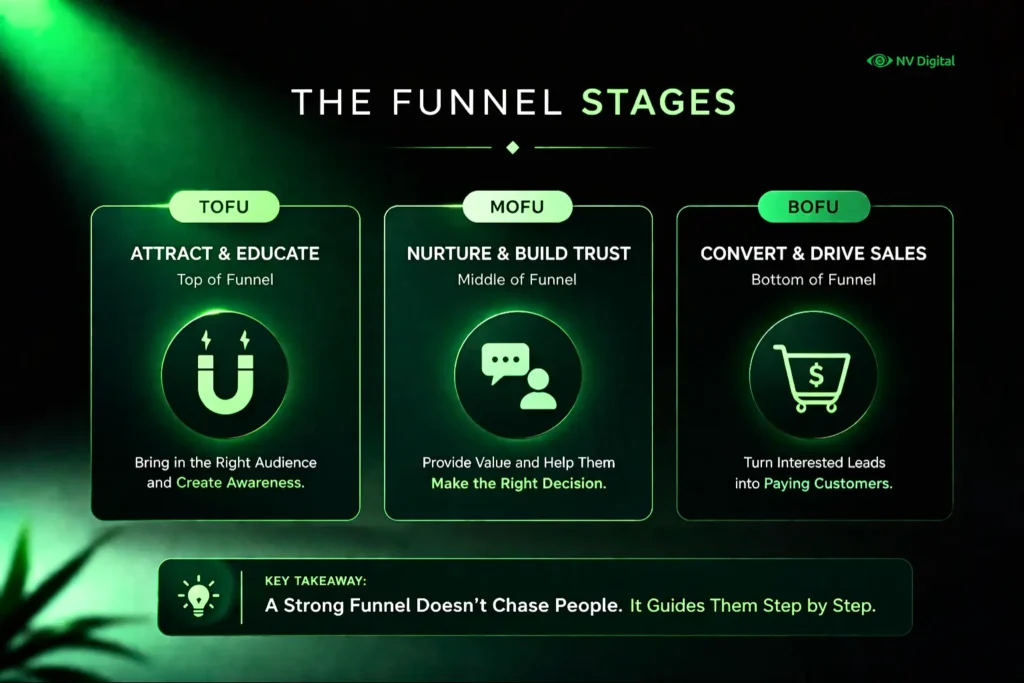
You have probably heard about TOFU, MOFU, and BOFU, but instead of focusing on definitions, it is more useful to understand what people are actually thinking at each stage.
Top of Funnel – The “Something is Off” Stage
At the top of the funnel, people are in the “something is off” stage. They are not searching for your product yet, they are trying to understand their situation. They may ask questions like why their ads are not working, why their website is not converting, or how to get more sales online. At this point, they are aware of a problem but not fully aware of solutions. If you try to sell here, it feels out of place. What works instead is helping them understand the problem clearly. When something finally makes sense to them, they remember your brand, and that is the real goal at this stage.
Middle of Funnel – The “What Are My Options?” Stage
In the middle of the funnel, people move into the “what are my options” stage. Now they clearly know they have a problem and are actively looking for solutions. They may compare services, read reviews, watch videos, or ask for recommendations. At this stage, trust becomes very important. If your business is not visible or helpful, they will move to your competitors. Instead of aggressive selling, what works here is guiding them in a clear and helpful way. You should show how your solution works, why it works, and who it is best for, while also reducing any uncertainty they may have.
Bottom of Funnel – The “Should I Do This Now?” Stage
At the bottom of the funnel, people are in the “should I do this now” stage. They are very close to making a decision, but hesitation still exists. They may wonder if it is worth the price, if it will actually work, or if they should wait. Your role here is not to push them aggressively, but to remove any friction in their decision. Clear pricing, strong testimonials, a simple process, and a clear next step can make a big difference. Even small confusion at this stage can delay or stop a conversion.
How to Build a Sales Funnel Step by Step (Practical Approach)
Now let’s put everything together in a real, usable way.
Step 1: Start With a Clear and Specific Offer
This may sound simple, but this is where most funnels fail. When your offer is vague, your funnel becomes weak.
Instead of saying that you provide digital marketing services, it is better to clearly explain the result you deliver, such as helping ecommerce brands reduce their ad costs and increase conversions within 60 days.
Clear messaging attracts the right audience and naturally filters out people who are not a good fit.
Step 2: Create an Entry Point That Feels Worth It
People do not want to take a risk on a business they are not familiar with, so you need to offer something that feels safe and valuable.
For service businesses, this can be a free audit, a strategy call or a customized analysis. For ecommerce, it can be a first time discount, free shipping or a bundle offer.
The goal is simple, which is to give people a clear reason to take the first step.
Step 3: Capture Attention Properly (Don’t Waste Traffic)
Many businesses spend money to bring people to their website, but they fail to capture them. When someone visits your page and leaves without taking any action, you lose that opportunity.
Instead, you should guide them to take a simple step such as filling out a form, entering their email or starting a chat.
Once you capture their details, you can continue the conversation and build a relationship.
Step 4: Build a Nurturing System That Feels Natural
This is where most businesses make mistakes. They expect people to convert immediately, but in reality, people need time to decide. Your follow up should feel like helpful guidance, not pressure.
You can start by sharing value in the first message, then explain common mistakes, show real results, and finally introduce your offer. This approach helps build trust step by step.
Step 5: Design a Conversion Experience, Not Just a Page
At the bottom of the funnel, details matter. Your page or process should feel clear, simple and trustworthy. You should avoid distractions, focus on one main goal and make it easy for people to take action.
Step 6: Use Retargeting to Bring People Back
Most people will not convert on their first visit and that is completely normal. Retargeting helps you stay visible to them, but instead of repeating the same message, you should improve and adapt it.
You can show testimonials, case studies and relevant offers to build more trust and familiarity over time, which increases the chances of conversion.
Real-Life Funnel Examples (Clear and Relatable)
Service Business Funnel
A person sees an ad offering a free audit and decides to sign up. After that, they receive a personalized report that clearly explains what is not working. They then get follow up emails with similar case studies that build trust and understanding. Finally, they are invited to a strategy call. By this stage, they are no longer cold leads, but informed and confident to move forward.
Ecommerce Funnel
A person sees a product video but does not buy at that moment. Later, they come across reviews and testimonials that build trust. After that, they receive a discount email, which encourages them to take action. They then return and complete the purchase. This is an example of a working funnel.
Common Mistakes That Quietly Kill Conversions
One of the biggest mistakes businesses make is trying to do everything at once. They mix awareness, education and selling in a single step, which ends up confusing people.
Another common mistake is ignoring follow up. Leads may come in, but there is no structured communication to guide them further.
There is also the problem of overcomplication, where businesses create too many pages, steps and decisions, making the process overwhelming.
A good funnel should feel simple and easy to follow, even if the strategy behind it is strong.
Pain Points Every Business Owner Faces (And How Funnels Solve Them)
If you feel like you are getting traffic but not making sales, your leads are not serious, your ads are becoming expensive or people stop responding after showing interest, these are not random problems.
These are clear signs of a missing or weak funnel.
A proper funnel helps you attract the right audience, build trust before selling and increase conversions without needing more traffic.
Frequently Asked Questions
Do I really need a marketing funnel if I already have a website?
A website alone is not enough because it does not guide users step by step. A funnel creates a structured journey that moves people toward a decision instead of leaving them to figure things out on their own.
How do I know if my funnel is working properly?
If your funnel is working, you will notice consistent lead flow, better conversion rates, and lower cost per acquisition over time. More importantly, leads will feel more qualified and ready to take action.
Can I build a funnel without running ads?
Yes, you can build a funnel using organic traffic like SEO, content and social media. However, ads can help you scale faster once your funnel is working.
Why do people drop off even after showing interest?
People drop off when they feel uncertain, confused or not fully convinced. This usually happens due to weak follow-up, unclear messaging or lack of trust signals.
How simple should my funnel be?
As simple as possible. The best funnels remove unnecessary steps and focus on guiding the user clearly from one stage to the next.
Conclusion
A marketing funnel is not just a strategy, it is a way of thinking. Instead of asking how to get more traffic, you start focusing on how to guide people in a better way.
This shift changes everything. When your funnel is clear, your marketing becomes more effective, your conversions become more predictable and your business starts growing with less friction.
That is what truly matters in 2026.
0 Comments