

SEO is not broken, Your SEO is outdated. If you’re doing the same things you did in 2020 or even 2023, like writing keyword-stuffed blogs, buying random backlinks and hoping Google magically rewards you – then yes, SEO will feel dead.
Many websites fail because they don’t really understand SEO basics – if you want a clear idea, check out what is SEO?
Today, SEO works when you align with how modern search engines judge quality, relevance and usefulness. The drop in results isn’t because SEO failed. It’s because the rules evolved.
This guide explains why SEO feels like it stopped working, what actually changed, what you should do differently now and whether SEO is still worth your time and money.
No hype. Just what works today.
Table of Contents
First, What Is SEO?
SEO means helping the right people find you when they are already looking for a solution.
Example: If someone searches: “why my ads are getting clicks but no sales”
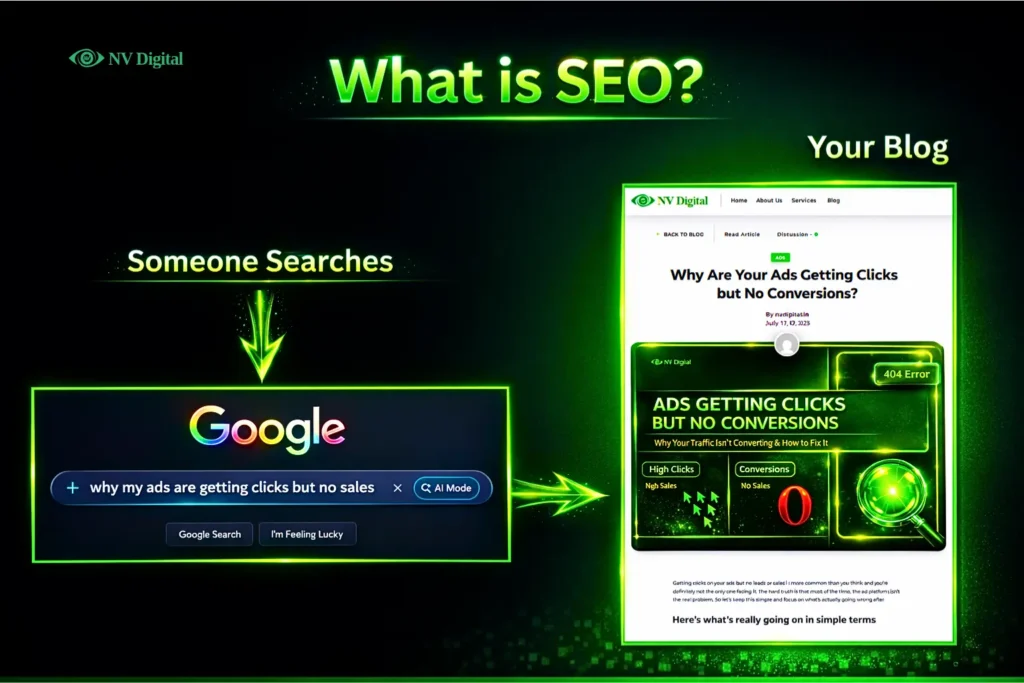
And your blog explains exactly why and how to fix it. SEO helped that person find you.
| Good SEO Means | Bad SEO Means |
|---|---|
| Your page shows up | You repeat the same advice that everyone else wrote |
| It explains the real reason | You talk around the problem |
| It tells them what to do next | You never answer clearly |
That’s it. SEO isn’t about tricks, hacks or trying to game Google.
The One-Line Answer
SEO is not dead.
The “ten blue links” version of SEO is gone. Search is no longer one page, one engine, one result list.
People now get answers from AI tools like Google AI overview, ChatGPT, Gemini or Grok often without clicking anything.
To stay visible in 2026, you must stop trying to “rank pages” and start helping humans first; machines and algorithms will trust you as a source automatically.
Old SEO vs New SEO (Quick Reality Check)
| Feature | Old SEO (The Traffic Era) | New SEO (The Visibility Era) |
|---|---|---|
| Core Philosophy | Optimize for the Robot (Crawler). | Optimize for the humans first with long-term query in mind. |
| Primary Goal | Rank #1 on Page 1 (10 Blue Links). | Be the “Cited Source” in the Answer. |
| Keyword Strategy | Exact Match / Keyword Density. | Topical Authority / Entity Coverage. |
| Content Volume | “Content is King” (More is better). | “Still Context is King” (Less, but deeper/verified). |
| Authority Signal | Backlinks (Quantity/DA). | E-E-A-T / Digital PR / Brand Mentions. |
| Production | Programmatic / Outsourced. | Lived Experience / Expert Authorship. |
| User Journey | Linear Funnel (Search -> Click -> Action). | Fragmented Loop (Chat -> Search -> Verify -> Action). |
| Success Metric | Sessions / Pageviews. | Share of Voice / Entity Sentiment / AI Referral. |
| Format | Text-heavy Blog Posts. | Hybrid (Text + Video + Data + Schema). |
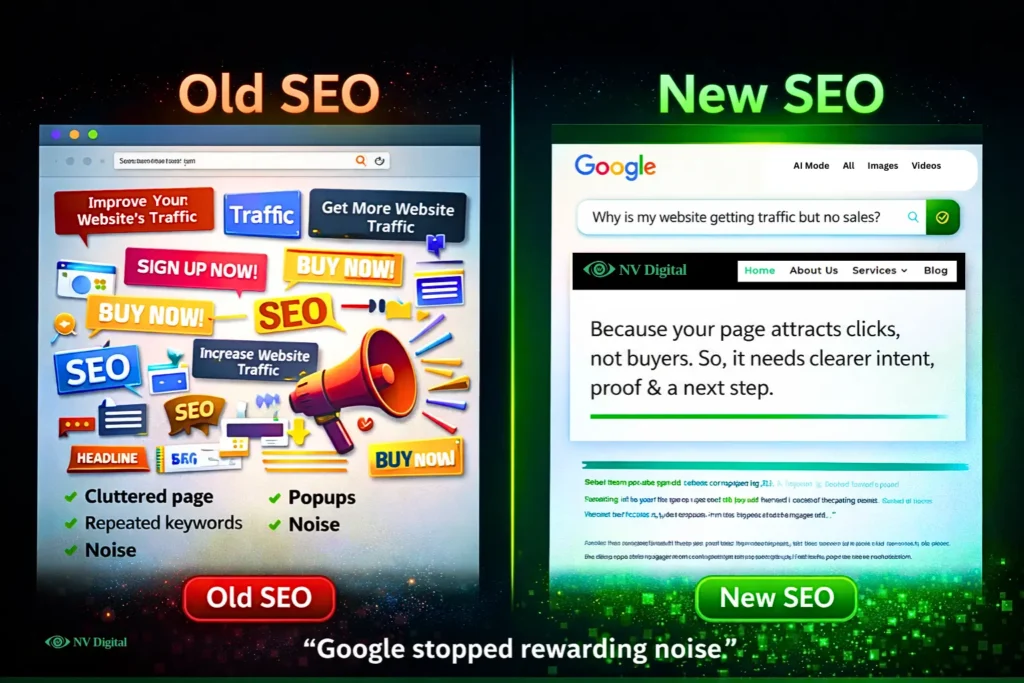
Why Your SEO Feels Broken Right Now
Google doesn’t favor old-style SEO anymore because it was filled with keyword stuffing, spammy backlinks and a lot of low-value content. What Google prefers now is content that genuinely solves people’s questions and shares real experience or practical insight they can actually use.
Google Avoid Outdated Old SEO
The video above was created using Grok Imagine. You can turn your ideas and imagination into visuals with Grok. If you want to learn more about it in detail, you can visit the Grok AI image and animation review page.
If SEO feels like it’s not working, there’s usually a clear reason behind it.
First, people often expect quick answers directly on the search page, so they don’t always need to visit a website. That can reduce your traffic even if your content is genuinely helpful.
Second, a lot of content online says the same things. If your page doesn’t add new insight, clearer explanations or deeper help, there’s no strong reason for search engines to show it over similar articles.
Finally, you might be looking at the wrong data. Someone can discover your brand through search, leave, and come back later by typing your website name directly. That visit shows up as “direct traffic,” not SEO. So search may still be helping, you’re just not seeing the full impact clearly in your reports.
New SEO Terms (Explained Simply)
You’ll hear new words everywhere. Here’s what they actually mean:
| Term | Full Form | Primary Target | What It Really Means |
|---|---|---|---|
| AEO | Answer Engine Optimization | AI Overviews / Voice | Writing clear answers AI can use |
| GEO | Generative Engine Optimization | ChatGPT / Perplexity | Getting cited by AI tools |
| VEO | Video Engine Optimization | YouTube / TikTok | Showing up through videos |
| SXO | Search Experience Optimization | User Behavior | Making pages easy to use and act on |
| LLMO | Large Language Model Optimization | AI Training Sets | Structuring content so AI understands it |
These don’t replace SEO. Still, fundamental SEO is the mother, they are just the new shape of it.
So… Is SEO Still Worth It in 2026?
Yes, but only if you stop doing it the old way.
SEO today isn’t about tricks. It’s about being clear, useful, real, and consistent in the way you create and share content. It’s no longer a shortcut to quick traffic. It’s the foundation of building long-term visibility and trust online.
SEO Still Worth It in 2026
The SEO Question Everyone Asks
Is SEO dead? The answer is ‘No.’
People have been saying SEO is dead for a long time but the truth is, SEO isn’t dead. It has just evolved. While old tactics no longer work, the core of SEO is very much alive. That’s the hard truth, even if some people refuse to accept it.
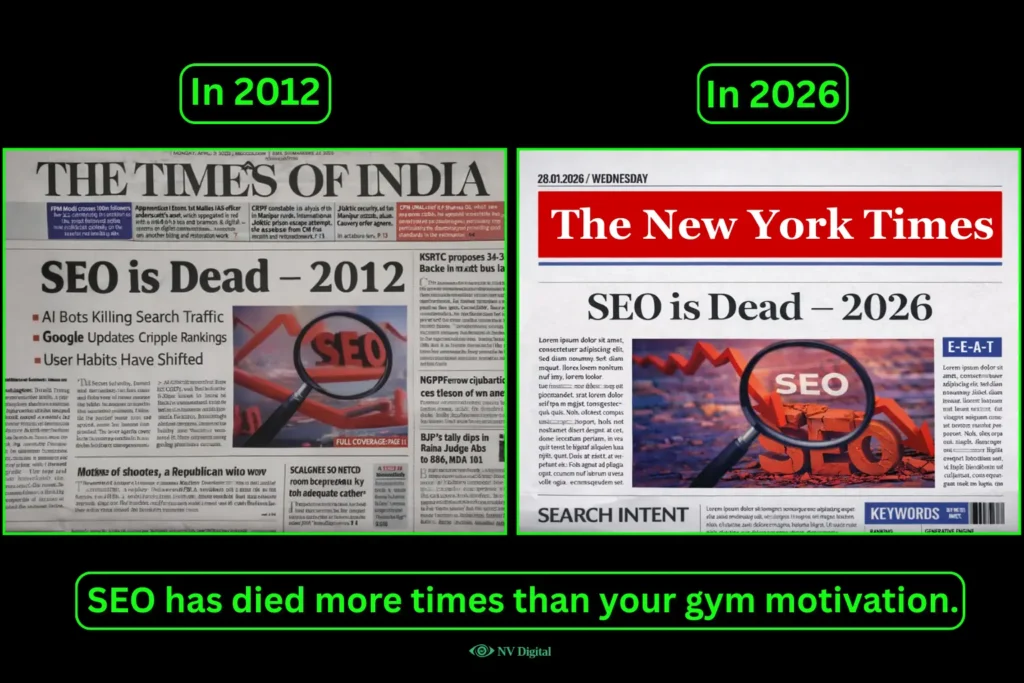
Shortcut SEO is dead – Remember when you could just rewrite what someone else wrote, sprinkle in a few keywords, publish long but empty blogs and throw up some random backlinks and Google would still send traffic your way? Those days are gone. Do you really think shortcuts like that will work today?
SEO that helps people, earns trust and shows real experience is very much alive.
What You Should Do Next (No Tricks)
- Stop publishing content just to rank
- Answer real customer questions clearly
- Update old blogs with fresh insights
- Add examples, proof and your own opinions
- Optimize for long-term queries and human readers
If your SEO strategy hasn’t changed in 2 years, then SEO could be dead.
FAQs
1. Will AI replace SEO agencies?
AI might replace agencies that just sell “deliverables” like “5 blogs per month.” But it won’t replace agencies that provide real strategy and help build a strong digital presence. Managing visibility across multiple platforms has become more complicated, so expert guidance is more important than ever.
2. How do I rank in ChatGPT?
You increase your “share of citation” by getting mentioned in top-ranking articles, building a strong online brand and publishing unique data that AI tools like ChatGPT reference. Using Bing Webmaster Tools is also important to improve your visibility on ChatGPT.
3. Is blogging dead?
“Content farming” is dead. Blogging to show your expertise is still alive but the approach needs to change. Today, blogs should be multimedia hubs with videos, original data and strong opinions from the author.
4. Why did my traffic drop in January 2026?
You probably lost visibility for informational searches because AI Overviews took over or your content was penalized for being just “summary content.” Check your pages: Do they give new value or are they only collecting information from other sources?
5. Should I delete my old blog posts that aren’t getting visitors?
Yes, in many cases. Think of your website like a garden. If it’s full of old or weak posts, Google may see the whole site as low quality. Today, having hundreds of average posts is worse than having a few excellent ones. Instead of deleting everything, combine posts on similar topics into one strong, in-depth guide and remove the rest. This shows Google that your site is focused on quality, not clutter.
Final Thought
Search didn’t disappear, it evolved. Today, it’s not about shouting the loudest or stuffing keywords. It’s about being the answer people actually trust and rely on.
Focus on creating content that genuinely helps, teaches or solves problems, and both Google and your audience will take notice.
Do this right and you’re not just chasing traffic. You’re building authority, credibility and long-term growth.
0 Comments