

If you can’t name the exact cost of getting one real paying customer from each channel, your marketing is guesswork. No argument. No excuses. If you want to fix one thing first, start with your CPA.
Table of Contents
Quick question for Marketing Audit (one glance)
- Do you know the CPA (Cost Per Acquisition) for each channel today?
- Can you trace one customer back to one campaign?
- If you had to cut one channel tomorrow, do you know which it would be?
If you hesitated on two or more items, keep reading. This guide will save you money.
Why this is worth a cold shower and what most reports hide
Marketing dashboards love noise: clicks, impressions, reach, conversion rate graphs. They’re shiny and they make the person who created them feel accomplished. Trouble is, shiny doesn’t pay bills.
A marketing audit is simply a systematic check to see whether your marketing systems, metrics, and processes actually match business outcomes not just activity. If you want the textbook definition, an audit verifies that your systems are accurate and aligned with your business goals.
So the real question is not “Did the campaign get clicks?” but “How much did those clicks cost me per customer?” That blunt question is the start line for every useful audit.
The single metric that forces accountability: CPA (say it out loud)
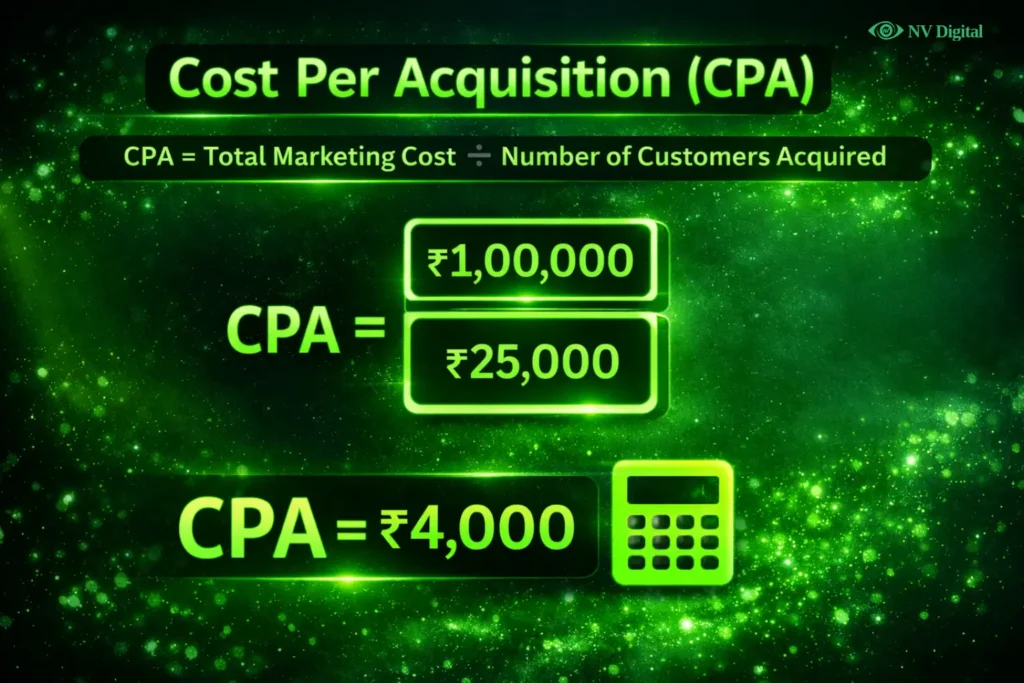
Cost Per Acquisition (CPA) = your total marketing cost ÷ number of customers acquired. It’s brutally simple and brutally honest. If you spent ₹1,00,000 and got 25 customers, your CPA is ₹4,000. That figure tells you whether a campaign is an investment or an expense.
Other metrics are helpful, but relying on them instead of CPA is like checking the fuel gauge by looking only at the odometer.
The audit you can run in 30 minutes (real, repeatable)
You don’t need a 40-page PDF or a consultant to get clarity. Do this now:
- Total all the marketing costs. Include ad spend, agency fees, design, landing page tools, everything. Don’t sneak things out.
- Pull actual customers for the period. Not leads, not meetings booked, real customers who paid.
- Calculate CPA. Spend ÷ customers = CPA. If it’s higher than one sale’s profit (or LTV), you’ve got a problem.
- Break CPA down by channel. Google, Meta, SEO, and email each tell a different story.
- Ask three questions: Should I scale, optimize, or stop this channel?
This process is the backbone of the best marketing audits I reviewed. Good guides advise dashboards to communicate results clearly, and use one to avoid wasting time.
A short example so this stops being abstract
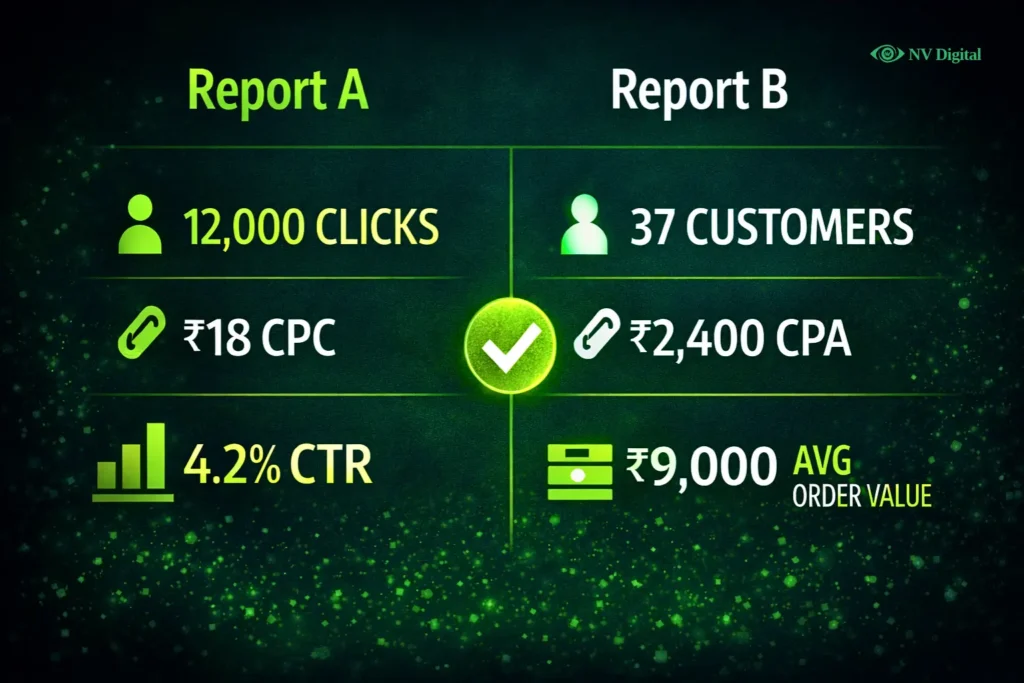
Say Channel A spent ₹50,000 and brought 8 customers (CPA = ₹6,250). Channel B spent ₹30,000 and brought 15 customers (CPA = ₹2,000). Channel B looks cheap, but what if Channel A customers buy more frequently? That’s why CPA must be compared to LTV (lifetime value) not guesswork.
If Channel A’s average LTV = ₹15,000 and Channel B’s average LTV = ₹3,500, your decision changes. Numbers force decisions; feelings don’t.
What to watch for (the messy traps that fool founders)
Tracking errors: wrong pixel setup, inconsistent UTM tagging, or missing offline attribution. These all show you the wrong numbers and produce false confidence.
Attribution mismatch: Different platforms use different windows and models. One channel may get credit for a last-click that was actually influenced by another. Fix the basics first (UTMs, server-side events) it’s non-sexy but it saves money.
Time mismatch: Some channels sell slowly (SEO), others fast (PPC). Don’t judge them on the same 7-day window.
These are common in the audit guides and why an audit must look at data quality, not just totals.
What a practical audit report should include (readable, not bloated)
A good audit report gives you the control panel, not the novel. At minimum, give me:
- One-line executive verdict: Spend more / optimize / stop.
- CPA by channel and the sample period.
- Traffic → leads → customers funnel with raw numbers.
- One prioritized action list (what to fix first; what to kill).
- A short “confidence” note (how clean the data is).
Top-performing posts follow the same pattern: concise findings, clear numbers, and an action plan. That’s how humans read and act.
Quick wins you can implement today (no agency required)
- Fix UTM tagging. Inconsistent tags wreck channel CPA comparisons.
- Check conversion tracking on your checkout/thank-you page. If it’s wrong, every CPA is a lie.
- Pause the worst CPA channel for 7 days; reallocate 20% of that spend to the best CPA channel and measure. Small bets, fast data.
These are the smallest changes that give the clearest signals. Do them before you design new creatives.
A short conversion-tracking checklist (use once, then forget)
- Are all paid campaigns tagged with consistent UTMs?
- Are conversions firing on the final “thank you” page (server-side if possible)?
- Is revenue or order value being passed to the ad platform?
If any answer is “no” fix it now.
How to read the results (and not panic)
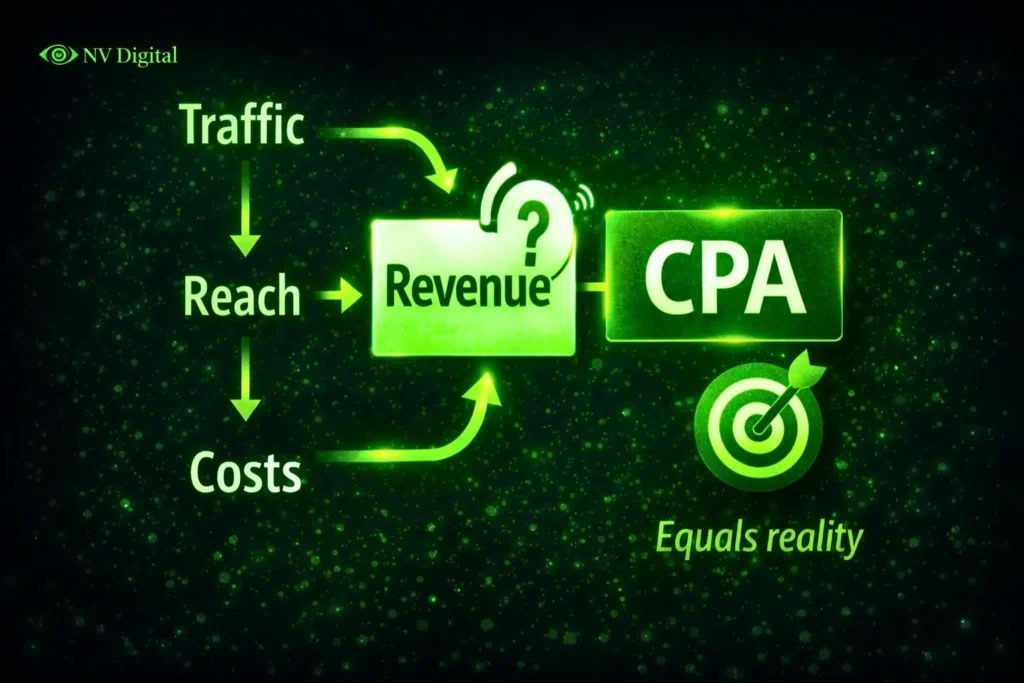
If CPA > LTV, stop or fix. If CPA < LTV, consider scaling carefully. If data is noisy, the first priority is data cleanliness, not strategy pivoting.
The best audits don’t create panic. They create a prioritized to-do list you can action in the next two weeks.
FAQs
1. How do I know if my marketing is actually working?
If you can’t clearly say how much it costs you to get one paying customer, your marketing isn’t “working” – it’s just running. Real marketing works when you know your Cost Per Acquisition (CPA) and that number is lower than what a customer is worth to you.
2. What is a good Cost Per Acquisition (CPA)?
A “good” CPA is different for every business. The simple rule: your CPA must be lower than your customer’s Lifetime Value (LTV). If you spend ₹3,000 to get a customer who only brings ₹2,000 in profit, you’re paying to lose money.
3. What’s the difference between a busy campaign and a profitable one?
A busy campaign shows high traffic, lots of clicks, and dashboards full of graphs. A profitable campaign brings paying customers at a sustainable cost. Activity looks impressive. Profit is what keeps the lights on.
4. When should I stop optimizing and start scaling?
Only after you have stable numbers. If your CPA is consistently profitable for at least a few weeks and tracking is accurate, then scaling is safer. Scaling before stability usually multiplies losses, not wins.
5. What does a healthy marketing funnel actually look like?
A healthy funnel shows a clear flow: traffic → leads → customers → repeat buyers. Drop-offs are normal, but if people enter and don’t move forward, the problem is messaging, offer or trust not just traffic volume.
Final words
If your marketing report makes you feel busy but not confident, it’s costing you money. If you’re not tracking Cost Per Acquisition, you’re not managing marketing, you’re observing it.
The businesses that win in the long term aren’t the loudest. They’re the clearest. And clarity always starts with the truth.



0 Comments