

Search is not what it used to be. Before, the target was simple. Rank number one on Google.
Now things work differently. People are getting answers straight from AI tools like ChatGPT, Google AI Overviews and Microsoft Copilot. They don’t always click links anymore. They just read the answer.
Because of this, a new focus has started. SEO and GEO. This is not a fight between the two. It is just the next stage of how search works.
Let’s understand it clearly with practical strategy, real examples and what is happening right now.
Table of Contents
What is SEO (Search Engine Optimization)?
SEO means improving your website so it shows up in regular search results on Google and other search engines. If you are new to this topic and want a clear explanation, you can read this detailed guide: What is SEO?
For example: when someone searches for digital marketing terms. If you have written a strong, well-optimized blog on it, SEO helps that blog rank higher and attract the right audience.
Modern SEO in 2026 (What Actually Works)
SEO today is no longer about keyword stuffing.
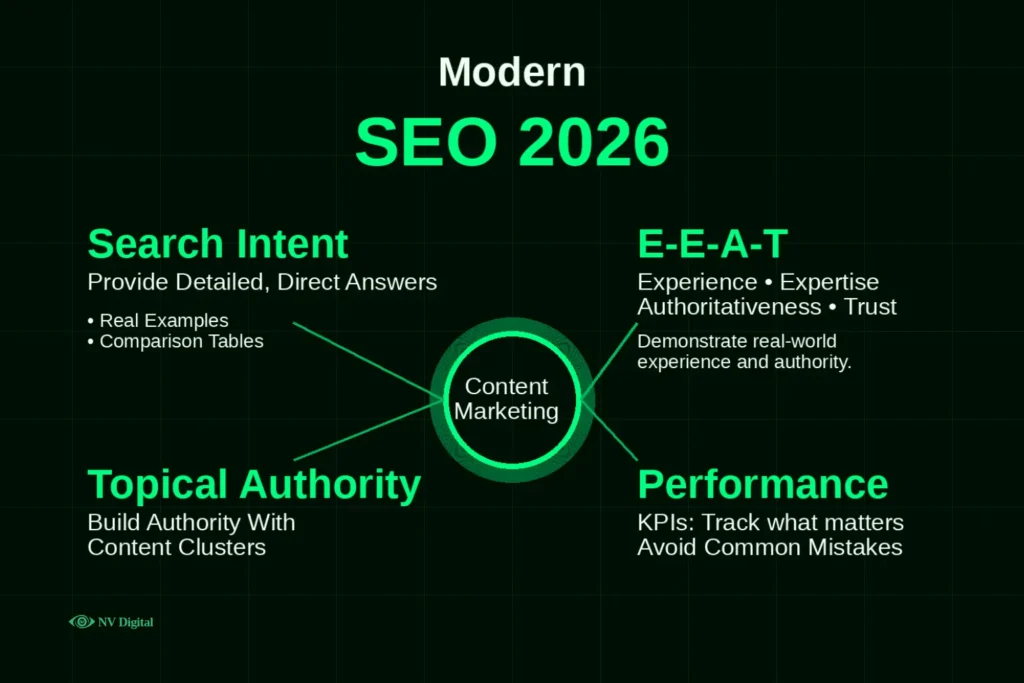
1️. Search Intent > Keywords
Google focuses on search intent, not just keywords. If someone searches “website redesign cost for small business,” they expect a clear pricing breakdown, real examples, comparison tables and a direct answer upfront & they are not looking for a generic article about web design.
2️. Topical Authority (Content Depth Strategy)
Instead of publishing random blogs, build content clusters around one core topic. For example, if your niche is content marketing, cover what it is, how the funnel works, key KPIs, common mistakes and include a case study. This structure shows depth and builds authority.
3️. E-E-A-T (Experience Matters More Now)
Google rewards content that demonstrates experience, expertise, authority and trust. To meet that standard, include real examples, screenshots, data, author credentials and case studies. In 2026, SEO is about building authority, not just ranking pages.
What is GEO (Generative Engine Optimization)?
GEO means creating content in a way that AI tools can easily understand, use and mention in their answers. Unlike SEO, the goal is not to rank on Google but to get your content included in AI responses.
Real Example
If someone asks ChatGPT, How often should a business update its website?, it provides a direct answer instead of listing multiple links. When your blog clearly explains how often updates are needed, presents information in simple bullet points, follows industry best practices and uses clear, factual language, AI tools are more likely to use your content in their answers. That is GEO.
Why GEO Became Important
Search has changed with the rise of AI answers, zero-click searches, and conversational queries. Users often read AI summaries instead of clicking links, so visibility alone no longer guarantees traffic. Authority now comes from being referenced in those AI responses.
This shift also means organic clicks are becoming less predictable, brand visibility inside AI answers matters more than traditional rankings and structured, fact-based content has a higher chance of being included.
Businesses that rely only on ranking positions risk losing attention, while those that build clear, trustworthy, well-structured content increase their chances of being cited by AI systems.
SEO vs GEO: Strategic Comparison
| Factor | SEO | GEO |
|---|---|---|
| Core Goal | Rank higher on search results | Get included or cited in AI-generated answers |
| Main Outcome | More website clicks | More brand visibility inside AI responses |
| Traffic Approach | Focused on driving organic traffic | Focused on being referenced, even without clicks |
| Optimization Focus | Keywords, backlinks, and technical setup | Clear context, structured answers, and credibility |
| Content Strategy | Pillar pages and keyword-focused articles | Answer-ready, well-structured, easy-to-summarize content |
| Success Metrics | Rankings, CTR, organic traffic | Mentions in AI answers, brand recall and assisted impact |
| Authority Signals | Strong backlink profile and domain strength | Trustworthy information, expertise, and original insights |
| Competitive Advantage | Better ranking position than competitors | Higher chance of being summarized or quoted by AI systems |
Advanced GEO Strategy (What Most Marketers Miss)
Here’s where we go deeper.
1️. Entity Optimization
AI tools understand specific names better than unclear terms. Instead of saying “AI tools are growing,” clearly mention platforms like ChatGPT, Google AI Overviews and Microsoft Copilot. When you use exact names, AI systems can recognize your content more easily and are more likely to reference it.
2️. Structured Formatting for LLM Parsing
Large language models respond better to content that includes clear definitions, bullet points, numbered lists, tables and FAQs. They struggle with long storytelling paragraphs, unclear statements and repeated keyword stuffing, so keeping your content structured and straightforward improves clarity and usability.
3️. Statistical Anchoring
AI systems favor content supported by specific data. Instead of saying zero-click searches are increasing, state that studies show over 50% of Google searches end without a click, especially for informational queries. Including clear numbers makes your content more credible and more likely to be referenced.
4️. Context-Rich Explanations
Instead of saying SEO helps businesses grow, explain it clearly. SEO helps local service businesses rank for high intent searches like emergency plumber near me, which brings direct leads. The more specific your explanation, the easier it is for AI systems to understand and retrieve your content.
5️. Featured Snippet Optimization (Bridge Between SEO & GEO)
Featured snippets are the closest example of GEO in traditional search. When you optimize clear definition paragraphs around 40 to 60 words, include tables and use step by step lists, you improve your chances of ranking higher on Google and increase the likelihood of being picked up by AI systems.
Case Scenario: SEO-Only vs SEO + GEO
Imagine two agencies that offer website maintenance.
Agency A focuses only on keywords and backlinks and ranks number three on Google.
Agency B also does SEO, but it creates clear guides, adds real statistics, mentions specific tools and platforms and includes helpful FAQs.
Because of this, Agency B not only ranks on Google but also gets mentioned in AI answers. More people recognize the brand and it stays visible for a longer time. That is the real long term advantage.
How to Implement SEO + GEO Together
Here is a practical framework you can follow.
First Step
Continue focusing on technical SEO by keeping your site fast, mobile friendly, using proper schema markup and maintaining a clean structure.
Second Step
Write your content in clear answer blocks. Every blog should include direct definitions, short explanation paragraphs and simple summaries so readers and AI systems can quickly understand it.
Third Step
Add expert signals by sharing real examples, relevant data, practical insights from experience and industry benchmarks.
Finally, focus on building brand mentions, not just backlinks. AI models learn from reviews, online mentions, discussions and industry citations, so digital PR and brand visibility matter more than ever.
The Big Misconception
It is not about choosing between SEO and GEO. Long term success comes from using both together. If you rely only on SEO, AI answers can reduce your clicks. If you rely only on GEO, you miss out on traditional search traffic. Smart brands combine SEO and GEO to stay visible everywhere and build sustainable growth.
FAQ’s
1) What’s the difference between SEO and GEO in 2026?
SEO focuses on ranking your website on Google through keywords, backlinks and technical setup. GEO focuses on getting your brand mentioned in AI generated answers from tools like ChatGPT or Gemini. SEO drives clicks, while GEO builds visibility inside AI responses.
2) Is SEO still worth it in 2026?
Yes. Google search still drives strong traffic, especially for commercial and buying-related queries. But AI tools now answer many informational questions directly, which can reduce clicks. So SEO is still important. It just isn’t enough on its own anymore.
3) How do you optimize content for AI mentions (GEO)?
Focus on clarity and authority. Create detailed content based on real experience, organize it in a clear structure, build strong brand credibility, and stay consistent within your topic. AI tools favor trustworthy and well structured information, not content overloaded with keywords.
4) Is AI search reducing website traffic?
For basic questions, AI usually provides a direct answer, so users may not click through. But for in-depth research, comparisons or buying decisions, people still visit websites. Traffic is shifting, not vanishing.
5) Which matters more in 2026: SEO or GEO?
Both are important. SEO drives your site traffic, while GEO ensures your brand is cited in AI answers. For lasting visibility, you need both.
Final Thoughts
Search is no longer just about ranking higher. It is about being trusted. Rankings bring visibility, but references build authority. Brands that focus only on position will lose ground as AI answers reduce clicks. Brands that build clear, credible, and structured content will stay visible in both search and AI. In the AI era, trust determines who wins.

0 Comments